
Effect of BIOBRAS-16® biostimulant on coffee hypocotyledonary graft attachment
Article Sidebar
Main Article Content
Abstract
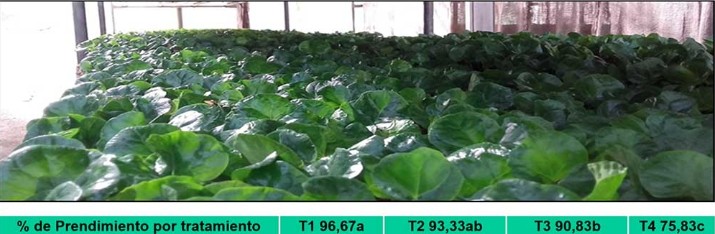
The experimental work was developed in the coffee graft acclimatization nursery of the Third Front Agro-Forest Experimental Station, Santiago de Cuba province at 150 meters above sea level, with the objective of evaluating the effect of different concentrations of the biostimulant BIOBRAS-16® on the budding. of hypocotyledonary graft of Coffea arabica L grafted on rootstock of Coffea canephora P. The average temperature ranged between 25 and 26 °C and the relative humidity was maintained at 90%. Four treatments were carried out, soaking for 3 hours depending on the treatment. The morphoagronomic indicators evaluated were: attachment percentage, plant height (cm), dry mass (g), root volume (cm3), stem diameter (cm). The study of the data was carried out through a descriptive analysis for the variable percentage of attachment and color, the rest of the variables were verified to meet the theoretical assumptions, a simple classification ANOVA and the comparison test of means were carried out. by Duncan for p<0.5 with the statistical package Statistic version 8.0. The Cuban biostimulant BIOBRAS-16® favors the efficiency of graft take, as well as the subsequent survival of the grafted plants. Imbibition in BIOBRAS-16® prior to grafting Coffea arabica L. buds on Coffea canephora P. rootstocks increases the morphoagronomic indicators evaluated (plant height, stem diameter, total and root dry mass), the most promising being T3 (imbibition the buds for three hours in 0.5 x10⁻³ mg/L of the biostimulant).
Article Details

This work is licensed under a Creative Commons Attribution-NonCommercial 4.0 International License.
References
Cabrera, L. M., Lago, P. E., Mendoza, E.M. J y Pérez, C. M. (2007). Acción fisiológica del BIOBRAS-16® en el proceso de floración fructificación y rendimiento en híbridos de tomate. Instituto de Investigaciones Fundamentales en Agricultura Tropical “Alejandro de Humboldt”.
Díaz Medina, Alejandro, Carrillo González, Adriel, & Suárez Pérez, Claribel. (2023). Efecto de bioproductos sobre el desarrollo de posturas de café en vivero. Revista mexicana de ciencias agrícolas, 14(4), 495-505. Epub 04 de agosto de 2023. https://doi.org/10.29312/remexca.v14i4.3303
Furio, R. N., Martínez, J. M., Fernández, A. C., García, Y. C., Ricci, J. D., & Salazar, S. M. (2023). Brasinoesteroides: Alternativa sustentable para mejorar la producción y calidad del cultivo de frutilla. Investigación Joven, 10(2), 140-140.
Hernández, S. E., y García, M.I. (2016). Brasinoesteroides en la Agricultura. Rev. Mex. Cienc. Agríc, 7(2), Texcoco feb. /mar.
Lorente,G.Y.,Hernández,D.R.,Rajo, L.C.,Ortiz, C.C., Guerra, R.D., Olmedo,J.G., Sanchez,R.R.(2021). Efecto de la aplicación de Biobrás 16 sobre el crecimiento y calidad de frutos de piña MD-2. Rev.CultivosTropicales, 42 (2).
Martínez-González, Lisbel, Reyes-Guerrero, Yanelis, Pérez-Domínguez, Geydi, García, María C. Nápoles, & Núñez-Vázquez, Miriam de la C. (2018). Influencia del Biobras-16® y el QuitoMax® en aspectos de la biología de plantas de frijol. Cultivos Tropicales, 39(1), 108-112. Recuperado en 25 de junio de 2024, de http://scielo.sld.cu/scielo.php?script=sci_arttext&pid=S0258-59362018000100014&lng=es&tlng=es
Morejón-Rivera, R., Díaz-Solís, S. H., & Castillo, A. M. (2021). Influencia de los bioestimulantes Biobras-16® y QuitoMax® en dos genotipos de arroz. Cultivos Tropicales, 42(4).
Núñez Vázquez, M., Reyes Guerrero, Y., Rosabal Ayán, L., & Martínez González, L. (2014). Spirostane analogs of brassinosteroids and their use potentialities in agriculture.
Reyes Guerrero, Y., Martínez. G. L. y Núñez.V.M. (2017) Aspersión foliar con BIOBRAS-16®. estimula el crecimiento de plantas jóvenes de arroz (oryza sativa l.) sometidas a tratamiento con NaCL. Cultivos tropicales, 38 (1), 155-166 enero-marzo.
Reyes Guerrero, Y., Núñez Vázquez, M., Mazorra Morales, L. M., Martínez González, L., Ravelo Agüero, E., Menéndez Rodríguez, J. L., & Pérez Domínguez, G. (2021). Mecanismos de acción de los brasinoesteroides y sus análogos en las respuestas de plantas sometidas a estrés abiótico. Anales de la Academia de Ciencias de Cuba, 11(2).
Rodríguez, J. L. C., Andrés, D., Gómez, M. C. C., & Lopez, H. E. B. (2022). Rol de los brasinoesteroides en frutales con énfasis en condiciones de estrés abiótico: Una revisión. Ciencia y Agricultura, 19(3).
Wei, Z. y Li, J. (2016). Los brasinoesteroides regulan el crecimiento, el desarrollo y la simbiosis de las raíces. Planta molecular, 9 (1), 86-100.